

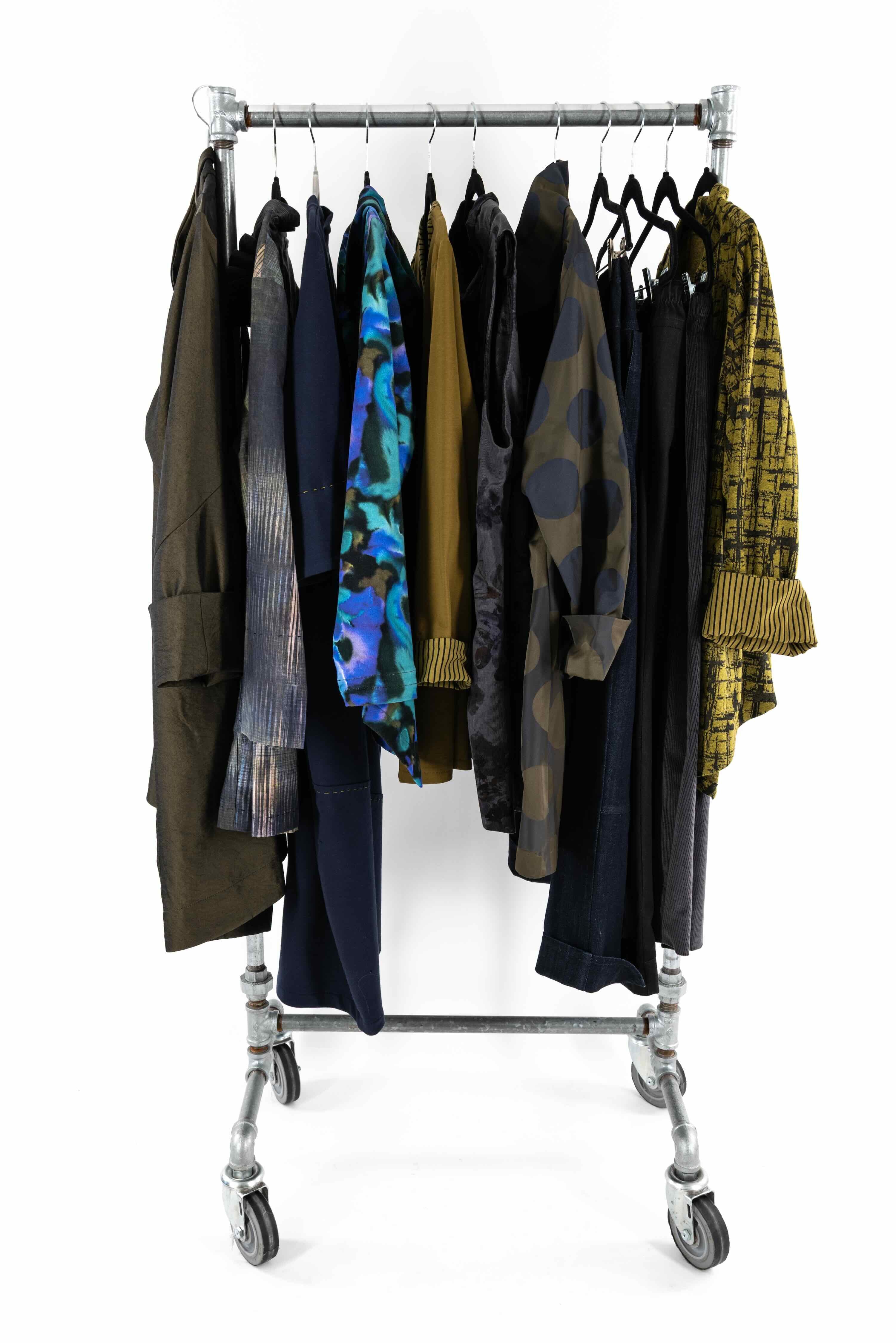
Creating and developing a core wardrobe is a concept I've been exploring for what feels like forever. I incorporate it into my own closet and used to teach it in my classes. A core wardrobe can be built from scratch or grown organically, by adding new pieces to what’s already in your closet. While my personal wardrobe’s core color is black, it could just as easily be navy, brown, green, or a blend of seasonal hues, like the ones shown here.
For fun, this fall Katherine and I put together a core wardrobe from scratch. This project was inspired by a magical moment while we were out in the ArtBarn on a Sunday afternoon playing with fabrics from our marcytilton.com collection. We started by tossing fabrics on the table to see what colors, textures, and patterns work together. A back-and-forth process led to realizing that what blends together is more important than perfect matching.
Take a look - we designed these garments to inspire our wonderful creative community to run with the idea and develop a core wardrobe (or a few pieces) that will work with your lifestyle, your own taste, personal coloring, what already exists in your wardrobe, and your fabric stash. It took about a month to make the garments. Katherine and I each made a few pieces and our friend Jean stitched up the rest.
This core wardrobe is the result. 11 pieces in all: Coat, Jacket, Vest, Shirt, Cardigan, Hoodie, T-shirt, Dress, 3 pants. Pockets in almost everything - the next version of a t-shirt will have pockets, and we are already planning future garments to work with this core! With a Paris trip on the horizon, we were inspired by travel, but the concept can work from country casual to city chic.
Coat that goes over everything:
The coat is the key piece that ties things together and easily layers over everything else, while blending the other colors and patterns. It can serve as a neutral, a solid, or feature a pattern or print. Consider how the length, neckline, and sleeves will nest together with the other garments. We used Butterick 6919 in Fir and Moss, a smooth, double-sided rainwear fabric that stands on its own while blending with other pieces. The fabric's smooth surface allows the coat to glide easily over other garments, and it resists wrinkles. Plus, it folds up flat, making it perfect for travel or everyday wear. The coat design features curved seams that can be sewn to the outside with raw edges or stitched right sides together. We tested sewing the seams to the outside, but the result was not right - stitching right sides together, then serging the edges worked beautifully. 


Jacket that layers under the coat, over the vest, and cardigan:
We used V1817 in Double Dot Jacquard Taffeta. I search for and love this kind of fabric. It could be silk, nylon, or polyester like this: thin and smooth yet with enough crispness and structure to work as a jacket. It crushes, yet wrinkles fall out, and other fabrics will slide over/under easily. I swapped out the collar from another pattern, V9230, cut on the bias so it lies softly and can be worn up or down. We eliminated the horizontal seams and used the reverse side of the fabric for the side panels and sleeve facings.


Vest that fits under (or over) the coat and jacket:
Cozy yet lightweight, the vest is V1817 made in Dusk Garden, a soft and supple Japanese micro-wale corduroy. Here too, I eliminated the horizontal seams. The small collar nests perfectly with the jacket and coat. Love how this soft floral print blends with the other colors and patterns in the jacket, coat, cardigan, and pants. 


Knit Top/s, T-Shirt or Shell: could be knit or woven with your best neckline, body shaping, and sleeve length, and will nest under the vest/jacket/coat:
V9027 is Marcy’s go-to basic T-shirt, made in Bronze Green—one of our fabulous Dutch cotton knits—accented with Greenway Stripe USA Knit. I’ve made several variations of the pattern, experimenting with different necklines, silhouettes, hem lengths, and sleeves, which makes cutting and sewing quick and easy. However, I always fit as I sew, since each knit hangs differently; I pay close attention to adjusting the neck shape and shoulder width for the best fit. Using a stripe for the neckband and facing adds a touch of contrast, and I love collecting stripes specifically for this purpose. Having about a yard on hand gives just the right amount to experiment with. When cutting strips for the neck binding, I rely on my heavy metal ruler—2" by 48"—to ensure precise, straight cuts.


Pants:
Slimline pant
Katherine and I each made a slim-lined pant in stretch denim. Katherine used B6668 in Vida Blue Stretch Denim
Marcy used V8859 in Ebony Mist Stretch Denim, adding front double welt pockets.
Soft pant in a silhouette and length that flatters your figure
Marcy used V1959 in Frisco Fog Stretch Corduroy, using a striped lining fabric from her stash for the pocket facings. As wider-leg pants become a popular trend, I’ve been exploring ways to adapt the length, width, and shaping into softer, fuller silhouettes. For fall, I cut this pair slightly longer than my warm-weather versions and adjusted the width along the side seams for a look that is right with the corduroy.
Cardigan that goes over the t-shirts and under the jacket or vest
V1959 in Etched Moss Knit worked like a charm - it is soft and cozy, feels delicious! Do bookmark this pattern as an ideal layering piece. The only thing I would change is to lengthen it by 2-4”. Using a fabric where both sides show is a must. Since this knit does not ravel, we simply turned under the edges ⅝” and topstitched in place to finish off the front edges and hem.


Shirt/Shirt Jacket:
Your version of a button-up shirt that works with the t-shirts and tops --- ideal if the vest slips over. Ranges from a classic shirt, to jean jacket, to Miyake big shirts.
Katherine loves and wears shirts almost every day. For this version, she used B6689 in Taj Indian Cotton, cutting on both the straight grain and bias to highlight the seam details. She further emphasized the design with hand stitching, giving it a personalized and polished touch.


Skirt or Dress in a shape and length that works on your figure, in your life, and goes with any/some of the other pieces.
We opted for a dress, a favorite, B6784 in Cadet Navy Danish French Cotton, an ideal fabric for this sculptural style. It’s incredibly comfortable, cozy, and flattering. Katherine added delicate hand stitching in olive green along the seams to highlight the design details. Interestingly, this dress looks best layered under the coat, as the lines of the vest, jacket, and cardigan don’t quite align perfectly on their own.


Hoodie: a modern garment that is part jacket, part cardigan, and can be kicked back or dressed up, fitted or slouchy, buttoned or zippered. I love a hoodie for everyday, for travel, as a casual extra layer.
Shown here made in V9244 using Blue Angel Dutch cotton French terry, which has a super soft brushed back side. Perfect with jeans, the vibrant print adds a splash of color and casual note to the core wardrobe.


In no special order, here are some ways the pieces combine and layer together.


